
Intellectual property rights are only as strong as the ability to enforce them. Counterfeit goods, pirated content, and unauthorised use of registered marks and copyrights cause real commercial harm.
IP infringement in Indonesia is classified as a complaint-based offence (delik aduan). Criminal proceedings can only be initiated by the rights holder or their authorised representative filing a formal complaint – the police will not act on their own initiative. Rights holders may withdraw the complaint within a statutory window if settlement terms are agreed with the target.
Complaint-based criminal enforcement is available for trademark infringement, copyright infringement, industrial design infringement, and patent infringement. In each case, the rights holder must demonstrate ownership of a valid and registered right in Indonesia before a complaint can be filed.
Before initiating enforcement, ensure the IP portfolio is up to date, including valid registrations, relevant customs recordals, and a review of the infringer’s IP position in Indonesia.
Related reading: IP Filings in Indonesia Grew 4.5× in a Decade: Key Trends
SKC Law’s Enforcement & Intelligence Team delivers four enforcement services: criminal raid actions, warning letters, online takedowns, and public relations. Strategy is built around client objectives. Services are available to rights holders directly, and to overseas IP service firms and law firms acting on behalf of their clients.
Criminal enforcement disrupts counterfeit supply chains, removes infringing goods from the market, and creates a deterrent effect. SKC Law executes criminal raid actions across multiple targets and provinces simultaneously, achieving seizures of tens of thousands of counterfeit goods across diverse product categories.
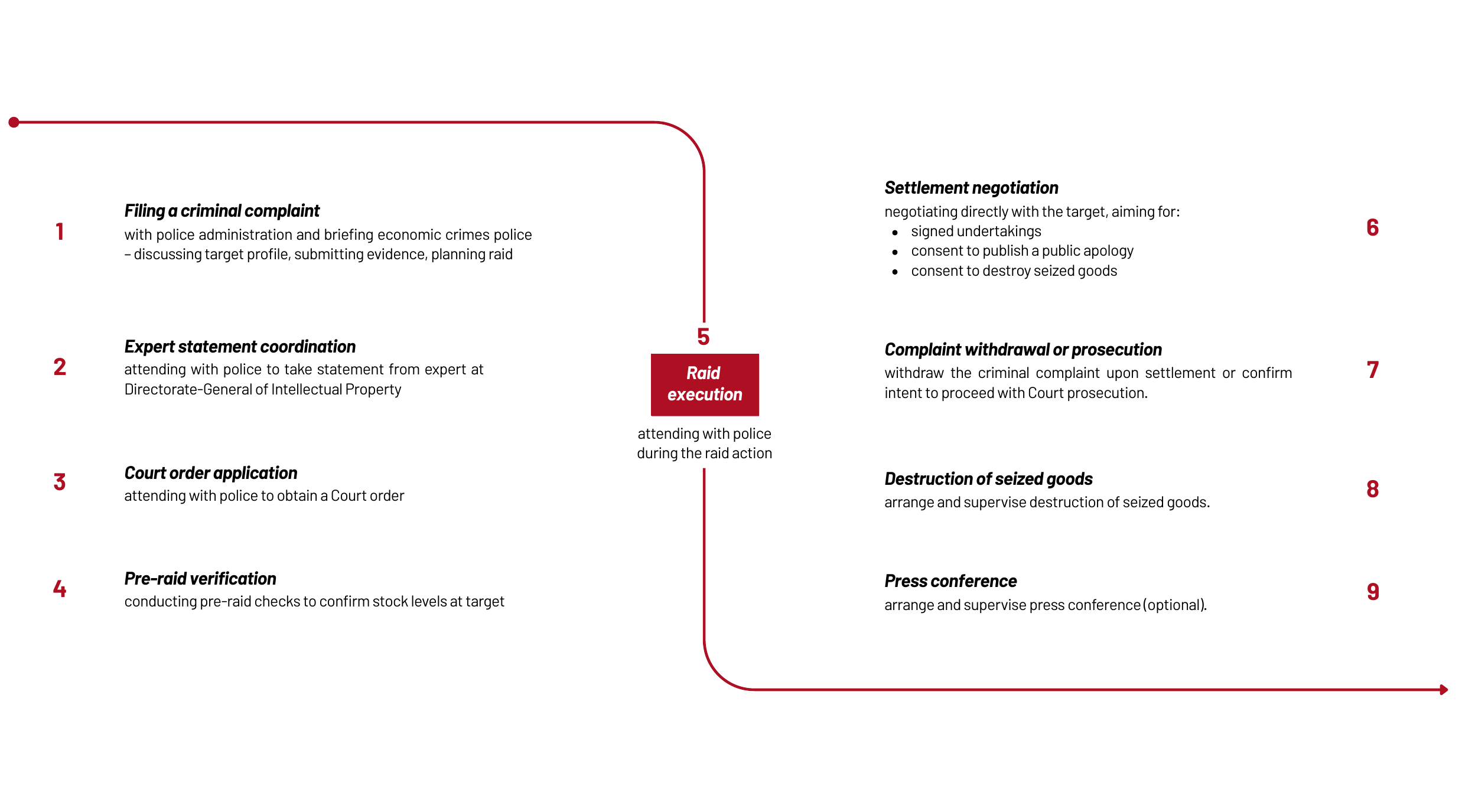
A criminal raid action is not a mechanism for recovering monetary damages. Rights holders seeking compensation should consider civil infringement proceedings in the Commercial Court as a complementary or alternative strategy.
Settlement negotiations can be concluded within three months of filing the complaint. After this period, continuation is at the discretion of the police.
Scaling enforcement – multiple targets and joint actions: Multiple targets within the same police jurisdiction can be addressed under a single criminal complaint. Each additional target requires separate pre-raid checks and raid attendance, but the complaint filing and DGIP expert statement do not need to be repeated, achieving broader market impact within a single enforcement cycle.
Joint raid actions are also possible where two or more rights holders share a common target. Combining enforcement under a single police operation improves efficiency and strengthens the deterrent signal, particularly where multiple brands are being counterfeited by the same network.
Related reading: Indonesia Criminal Law Reform: Key Impacts on IP Enforcement
Warning letters are often the most efficient first enforcement step – particularly where the infringing party is identifiable, operating at a smaller scale, or where a negotiated outcome is commercially preferable to immediate criminal action.
SKC Law prepares and issues warning letters and cease-and-desist correspondence on behalf of rights holders. Each letter reflects the rights holder’s legal position accurately, identifies the infringing conduct, and states the remedies sought, creating a clear record for potential subsequent proceedings.
Letters directed at the individuals behind platform accounts, not just the accounts themselves, reduce the risk of infringers reappearing under a different entity after initial correspondence. For smaller-scale infringers, a well-drafted letter from a recognised ip firm indonesia is sufficient to achieve compliance. Where it is not, SKC Law escalates to criminal enforcement or civil proceedings without delay.

Criminal raid actions target the physical supply chain. A growing proportion of infringing activity, however, takes place on e-commerce platforms and social media, where counterfeit goods can be listed and sold at scale with limited exposure to physical enforcement action.
Indonesia is Southeast Asia’s largest e-commerce market. Its major platforms, Tokopedia, Shopee, Lazada, TikTok Shop, Bukalapak, and Blibli, host a large, fragmented seller base in which counterfeit goods can appear across multiple storefronts simultaneously.
The scale of the problem has drawn international attention: the United States Trade Representative (USTR) has included Indonesian platforms in its Notorious Markets List, citing concerns over counterfeit availability and enforcement adequacy. In response, Indonesia’s DGIP, the Ministry of Communication and Digital Affairs, and major platforms have strengthened cooperation on IP enforcement. In 2025, over 20,000 infringing links were reported to authorities, with nearly 19,000 removed.
Despite these improvements, the burden of identifying and reporting infringing listings remains with the rights holder. Effective online enforcement requires active monitoring and systematic reporting.
Key to this framework is Permenkum 47/2025 established a dedicated mechanism for reporting copyright infringement Indonesia and other IP violations through electronic systems, covering e-commerce platforms, websites, applications, and social media. The regulation covers trademarks, patents, industrial designs, trade secrets, geographical indications, and communal IP, in addition to copyright.
Rights holders submit infringement reports to the DGIP, where a verification team, comprising representatives from the Ministry of Law, the Ministry of Communication and Digital Affairs, and relevant IP associations, examines each report and may recommend content takedown or access blocking. Blocked content can be reinstated if a licence agreement is reached or the parties resolve the matter through mediation.
SKC Law manages the full online enforcement process: identifying and documenting infringing listings, preparing takedown notices for platforms and regulatory authorities, escalating to DGIP where platforms fail to act, and coordinating offline enforcement where online investigations trace sellers to physical premises.
Related reading: New Mechanism for Reporting Online IP Infringement
Public relations is an integral, and often underutilised, part of an effective enforcement strategy. A successful raid or online takedown creates a powerful deterrent signal, but only if it reaches the right audience.
SKC Law arranges and supervises press conferences following criminal raid actions where this is commercially appropriate. A well-managed press conference communicates to the market that a rights holder actively defends its intellectual property rights in Indonesia, and that infringers face real legal and commercial consequences. This creates a deterrent effect that extends beyond the immediate targets of an enforcement action.
Public relations support from SKC Law includes:
The public apology, which SKC Law seeks to negotiate as part of settlement, is a related but distinct tool. Where obtained, it provides the rights holder with a public acknowledgment of infringement that reinforces the legitimacy of their rights and the effectiveness of their enforcement programme.
Indonesia’s intellectual property rights in indonesia enforcement framework covers trademarks, copyright, patents, industrial designs, geographical indications, and trade secrets, supplemented by the general criminal law framework. Key statutes include:
Indonesia is a member of the Paris Convention, TRIPS Agreement, and Berne Convention. Its trademark system operates on a first to file vs first to use basis – making registration, and its active defence through enforcement, critical for maintaining rights in Indonesia.
Related reading: Indonesia’s New KUHP and Intellectual Property Enforcement

In the past 12 months
Technology and telecommunication
One of Southeast Asia’s most popular mobile games faced threats from cheating software that undermines gameplay integrity and monetization. Our client engaged SKC Law to pursue copyright and EIT Law (UU ITE) enforcement against operators distributing unauthorized “mods” and hacks in Indonesia.
SKC Law initiated a comprehensive digital investigation targeting the ecosystem supporting the distribution of cheating software. The investigation mapped a complex network of websites, Telegram channels, and social media accounts actively promoting and selling game hacks to Indonesian users. These channels were supported by a wide array of local and international payment methods, allowing operators to monetize at scale while attempting to conceal their identities.
Through advanced open-source intelligence (OSINT) techniques, SKC Law traced digital identifiers across platforms, that linked to a primary suspect operating from Central Java, and prepared precedent cases for police coordination, and evidentiary frameworks tailored to Indonesian enforcement practice.
Industrials and manufacturing
Online activity increasingly serves as an entry point for identifying offline counterfeit distribution networks. A recent example involved products associated with a client, where suspicious promotional activity by a distributor on social media platforms, including TikTok, escalated into one of Indonesia’s largest counterfeit bearing seizures.
Initial investigation led to the discovery of storage and distribution locations in Bekasi and Tangerang. Coordinated enforcement actions were subsequently undertaken with the assistance of Polda Metro Jaya, resulting in the seizure of approximately 10.9 metric tonnes of suspected counterfeit bearings.
Further investigation focused on mapping the distribution chain and identifying upstream suppliers and downstream customers.
Common questions about IP enforcement in Indonesia. For specific advice, contact SKC Law at enquiries@skclaw.id.
Criminal enforcement in Indonesia is available for trademark infringement, copyright infringement, patent infringement, and industrial design infringement – provided the right is valid and registered in Indonesia. Proceedings are initiated by the rights holder filing a complaint; the police do not act independently. Sanctions include fines and imprisonment.
Settlement negotiations can be concluded within three months of filing the complaint. SKC Law routinely achieves negotiated settlements within this window, including signed undertakings, public apology, and goods destruction. Cases that proceed to criminal prosecution take considerably longer.
Yes. Permenkum 47/2025 established an administrative reporting mechanism that allows rights holders to submit copyright infringement and other IP infringement reports to the DGIP without initiating criminal proceedings. The DGIP-led verification process can result in content takedown or platform blocking, typically faster than criminal prosecution. Platform-level takedown requests to e-commerce platforms and social media are also available in parallel. For systematic or high-value infringement, combining criminal enforcement with online takedowns is most effective.
No. Rights holders based outside Indonesia can instruct SKC Law directly, or through their overseas IP firm or legal counsel. SKC Law handles all interactions with Police authorities, the DGIP, and the Courts. The rights holder’s obligations are to supply documentation confirming ownership of the relevant intellectual property rights in Indonesia, and to be available for approvals at key decision points.
A warning letter demands that infringing conduct cease and specifies the remedies sought. It does not initiate legal proceedings but creates a record of the rights holder’s position, and is often sufficient to achieve compliance. A criminal complaint formally initiates enforcement with the Police, triggering an investigation and, where evidence supports it, a raid action. Warning letters are typically issued first; where an infringer fails to comply, a criminal complaint is the logical next step. SKC Law manages both as part of an integrated enforcement programme.

This website uses cookies to ensure you get the best experience on our website. Read more
"(required)" indicates required fields